
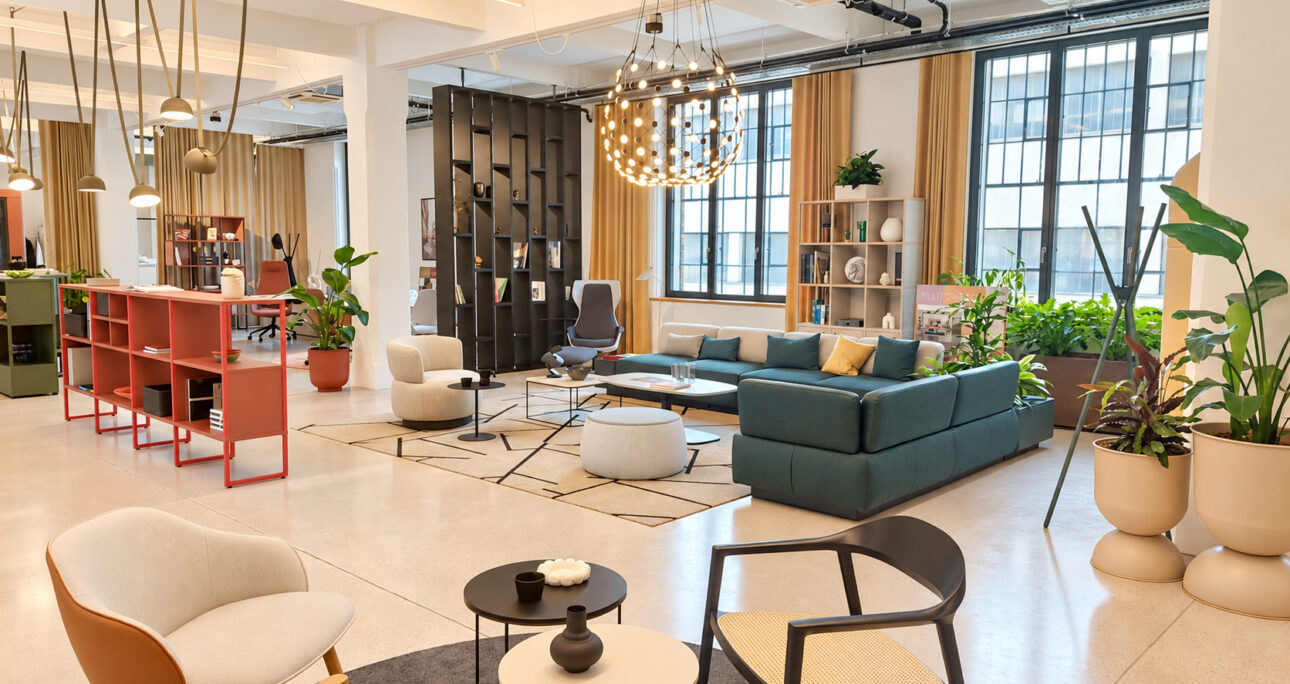
Can a German furniture manufacturer with more than 150 years of history be rooted in tradition, committed to sustainability, and surprisingly playful at the same time? After our two-day professional visit to the Sedus showroom in Vienna, our answer is a resounding yes.
Last week, the Capstone team headed to Vienna to explore the world of Sedus firsthand. We were joined on this two-day professional visit by the team from G-Green, Sedus’s Hungarian distributor. The programme brought together furniture design, ergonomics, architectural restoration, and, of course, a taste of Austrian cuisine. After all, no trip to Vienna would be complete without a little Wiener Schnitzel alongside the professional inspiration.
Industrial Heritage, Modern Workspaces
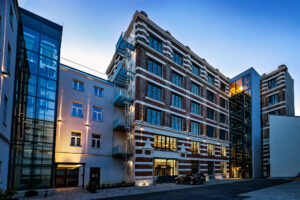
The venue itself deserves a chapter of its own. The Sedus showroom in Vienna is located within a remarkable historic building complex on Felberstraße. Originally built between 1889 and 1905 as a gas meter factory, the buildings served as an industrial production site for decades. The heritage-sensitive refurbishment has preserved the original brick architecture and industrial character while introducing contemporary architectural elements.
As interior architects, we find it particularly inspiring when a historic building is not simply given a new purpose, but its history becomes an integral part of the space itself. It is a great reminder that sustainability sometimes begins with choosing not to build everything from scratch.
German Precision, Without the Stiff Formality
Sedus has a history dating back to 1871, and its manufacturing remains firmly rooted in Germany. Sustainability has long been a cornerstone of the company’s philosophy, with durability, ergonomics, responsible material choices, and circular design principles at the heart of the brand’s approach.
What might come as a surprise, however, is the design language of its furniture.
When thinking of a German manufacturer, many might picture strict functionality, understated colours, and somewhat rigid designs. Sedus, however, deliberately challenges these stereotypes. Soft lines, inviting shapes, intriguing textures, and playful use of colour define its collections.
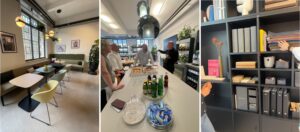
German precision is still very much there – it has simply traded its hard hat for something far more comfortable.
One of the highlights of the visit was, of course, the opportunity to experience everything firsthand. We explored the different surface finishes, examined material junctions and details, and sat in just about every chair we came across. Strictly for professional reasons, naturally.
After all, a piece of furniture may look perfectly designed in a catalogue, but the real test begins when you actually use it. The tactile qualities of materials, seating comfort, and the way a mechanism works are things that no rendering can ever fully capture.
Did You Know That Height-Adjustable Office Chairs Already Existed in 1890?
During our visit, we had the opportunity to discover not only Sedus’s products but also the brand’s history and the philosophy behind its designs.
One of the most fascinating stories involves Albert Stoll, one of the founders of the company’s predecessor, who developed a height-adjustable, swivel chair as early as 1890. Even more remarkably, he achieved this using bentwood and a threaded adjustment mechanism.
Yes, you read that right: ergonomic seating was already a topic of innovation at a time when office environments looked entirely different from those we know today.
Of course, there was still a long way to go before the modern office chair as we know it emerged, but the fundamental idea was already there: furniture should adapt to people, not the other way around. It seems some good ideas truly never go out of style.
Furniture History and a Taste of Viennese Charm
On the second day, we also visited Möbelmuseum Wien (Vienna Furniture Museum), where we explored the evolution of furniture design, from imperial splendour and 19th-century bentwood furniture to modern design. As interior architects, it was particularly fascinating to see how forms and functions have evolved over the centuries, and how many historical design ideas continue to inspire us today.
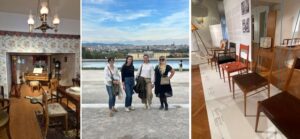
But the two days weren’t just about furniture. Alongside the professional programme, we also had plenty of opportunities to soak up the atmosphere of Vienna. Schönbrunn, the city’s elegant architecture, traditional Austrian cuisine, and, of course, the obligatory Wiener Schnitzel all added to the experience. And naturally, a little Manner chocolate made its way into our bags for the journey home.
One thing is certain: the next time we choose an office chair, we won’t just be thinking about its technical specifications, but also about the more than 150 years of innovation and development behind it.